
Summer Undergraduate Research Positions in Silviculture and Applied Forest Ecology
Seedling Field Crew Technicians or Crew Leader
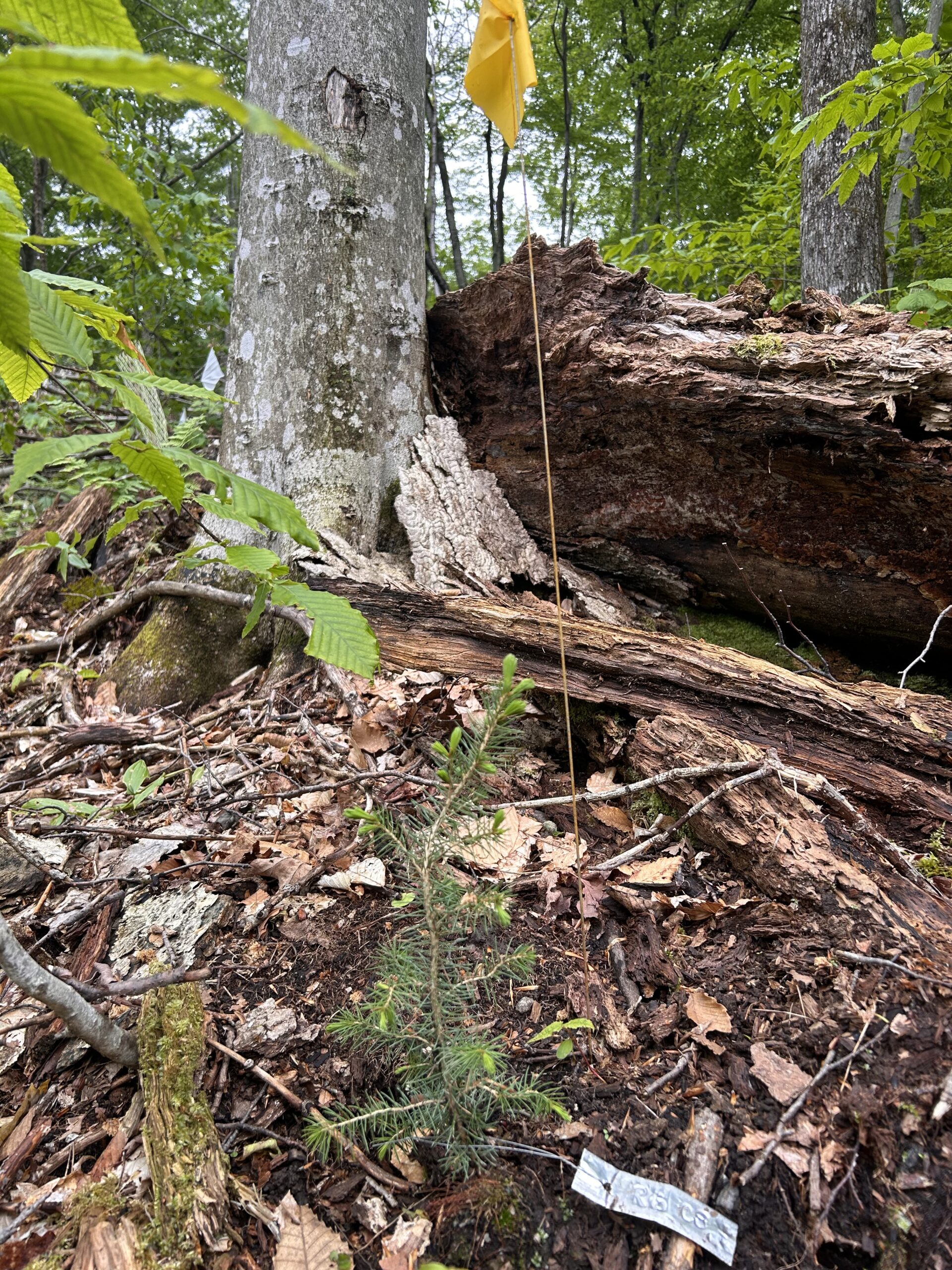
Project: The University of Vermont, Rubenstein School of Environment and Natural Resources is seeking 2-3 field technicians and 1 crew lead based out of Burlington, VT to assist on field studies examining the impacts of climate change and invasive species and associated adaptive forest management strategies on planted seedlings in northern hardwood, mixedwood, and spruce-fir forests across various locations in Vermont. Field technicians will work with multidisciplinary teams of graduate students and scientists from the University of Vermont, U.S. Forest Service Northern Research Station, U.S. Fish and Wildlife Service, The Nature Conservancy, Vermont Land Trust, Vermont Forest Parks and Recreation, and The Northern Institute of Applied Climate Science.
Crews will train with staff and agency personnel to learn the data collection protocols, methods, and techniques. Following training, crews will be responsible for planning daily trips, maintaining equipment, traveling to and from field sites, and conducting field work. In addition to these responsibilities, the crew leader will also be responsible for managing a safe and inclusive work environment, relaying consistent communications between supervisor and field crew, and making decisions in the field for the crew.
Primary responsibilities:
- Conduct site preparation, planting and measurement of seedlings in remote areas
- Conduct survival monitoring, maintenance and competition control of previously planted seedlings
- Routine maintenance and operation of brush saws for clearing vegetation
- Navigate to field sites using GPS and maps
- Ensure accuracy and consistency in data collection and management
- Collaborate with team members to support research goals
- For Crew Lead, maintaining communication with monitoring coordinator while out in the field
Required Qualifications
- Academic background in forestry, ecology or related fields
- Strong knowledge of forest inventory techniques and tree planting experience preferred
- Physically capable of hiking and conducting daily field work in rough terrain in harsh environmental conditions (heat, rain, biting insects)
- Crew lead applicants should have leadership experience and advanced field skills
- Valid driver’s license required
Physical Demands
Field-based roles typically involve data collection in remote locations with little to no cellular service. Crews will face challenging field conditions, including high temperatures, biting insects and heavy rainfall. Daily hikes of up to 5 miles while carrying up to 50 pounds will be required. Driving to designated sites for multiple hours and some 4×4 driving on unmaintained roads. Lodging will be provided during field stints to further locations, typically lasting 3-4 nights per week. There may be days where, due to travel, Field Technicians will be expected to work 10+ hours (when daylight allows).
Position Details
Supervision: Field Technicians will work primarily with their designated crew members, and occasionally with personnel from collaborating agencies and Silviculture and Forest Ecology lab members.
Location: Based in Burlington VT, with overnight travel of 3-4 days required for further locations for several weeks throughout the season (housing provided), field vehicle provided
- Start date: May 18th, 2026
- End date: August 13th, 2026
- Anticipated hours: 3 months, 40 hours per week (Mon-Thurs, 10 hours days)
- Compensation: $18-20 for crew members DOE, $20-22 for crew lead DOE
Interested candidates should e-mail a single PDF with cover letter describing their background, qualifications and interests along with a résumé and two references with subject line “Seedling Crew – Your Name” to Grace Smith(grace.smith@uvm.edu). Please indicate in your email if you would like to be considered for the Crew Leader position. Review will begin January 2026 on a rolling basis. Positions remain open until they are filled. All interviews will be conducted remotely using Microsoft Teams
NH Field Crew Technicians or Crew Leader
Project: The University of Vermont, Rubenstein School of Environment and Natural Resources is seeking 2-3 undergraduate field technicians and 1 crew lead to assist on field studies examining the impacts of climate change and invasive species and associated adaptive forest management strategies on northern hardwood, mixedwood, and spruce-fir forests in various locations across New Hampshire. Field technicians will work with multidisciplinary teams of graduate students and scientists from the University of Vermont, U.S. Forest Service Northern Research Station, U.S. Fish and Wildlife Service, The Nature Conservancy, and The Northern Institute of Applied Climate Science.
Crews will train with staff to learn the data collection protocols, methods, and techniques. Following training, crews will be responsible for planning daily trips, maintaining equipment, traveling to and from field sites, and conducting field work. In addition to these responsibilities, the crew leader will also be responsible for managing a safe and inclusive work environment, relaying consistent communications between supervisor and field crew, and making decisions in the field for the crew.
Primary responsibilities:
- Conduct forest inventory data, including overstory tree measurements, vegetation and regeneration surveys, coarse woody material assessments
- Conduct survival monitoring, maintenance and competition control of planted seedlings
- Routine maintenance and operation of brush saws for clearing vegetation
- Navigate to field sites using GPS and maps
- Ensure accuracy and consistency in data collection and management
- Collaborate with team members to support research goals
- For Crew Lead, maintaining communication with monitoring coordinator while out in the field
Required Qualifications
- Academic background in forestry, ecology or related fields
- Strong knowledge of forest inventory techniques and tree species identification preferred
- Physically capable of hiking and conducting daily field work in rough terrain in harsh environmental conditions (heat, rain, biting insects)
- Crew lead applicants should have leadership experience and advanced field skills
- Valid driver’s license required
Physical Demands
Field-based roles typically involve data collection in remote locations with little to no cellular service. Crews will face challenging field conditions, including high temperatures, biting insects and heavy rainfall. Daily hikes of up to 5 miles while carrying up to 50 pounds will be required.
Position Details
Supervision: Field Technicians will work primarily with their designated crew members, and occasionally with personnel from collaborating agencies and Silviculture and Forest Ecology lab members.
Location: New Hampshire, housing at each field site and field vehicle provided. Crews will move housing based on project.
- Start date: May 18th, 2026
- End date: August 13th, 2026
- Anticipated hours: 3 months, 40 hours per week (Mon-Thurs, 10 hours days)
- Compensation: $18-20 for crew members DOE, $20-22 for crew lead DOE
Interested candidates should e-mail a single PDF with cover letter describing their background, qualifications and interests along with a résumé and two references with subject line “NH Field Crew – Your Name” to Grace Smith(grace.smith@uvm.edu). Please indicate in your email if you would like to be considered for the Crew Leader position. Review will begin January 2026 on a rolling basis. Positions remain open until they are filled. All interviews will be conducted remotely using Microsoft Teams.
PhD Assistantship: Examining Ecological and Silvicultural Outcomes of Forest Adaptation Strategies at the University of Vermont
Project: Climate change and associated stressors, like non-indigenous insects and diseases, threaten the species and ecological, cultural, and economic values supported by forest ecosystems around the globe. Currently, there is limited knowledge of best adaptation strategies for addressing these impacts, particularly those that balance goals tied to biodiversity conservation, sustaining ecosystem productivity, and supporting cultural and economic values. To address this knowledge gap, The University of Vermont (Rubenstein School of Environment and Natural Resources) seeks a PhD-level graduate student to participate in a research project focused on evaluating forest ecosystem responses to co-produced adaptation experiments developed as part of the Adaptive Silviculture for Climate Change (ASCC) network. The PhD student will contribute to field-based efforts at ASCC installations in northern New England, as well as utilize network-wide data collections to synthesize outcomes tied to forest assisted migration efforts. They will join a team of collaborators from the University of Vermont, Northern Institute of Applied Climate Science, and wider ASCC network, as well as an extensive group of partners from Tribal, State, and Federal agencies, and non-profit organizations. A primary goal is to synthesize the actionable science needed to develop best adaptation practices that sustain services, values, and species for diverse partners into the future.
This position is available for Summer 2026 and includes four guaranteed years of funding (stipend, tuition waiver, and health insurance).
Application: Interested applicants should supply all application materials to the UVM Rubenstein School of Environment and Natural Resources (RSENR) Program (PhD in Natural Resources) by February 1, 2026 – when applying, please state your interest in this position in the “Statement of Purpose.“
Contact:
Dr. Anthony D’Amato (awdamato@uvm.edu, 802-656-8030)


MS Assistantship: Examining Assisted Migration, Restoration, and
Climate Adaptation of Northern Forests
Project: Relatively little is known about the best strategies for restoring and adapting forests to climate change in ways that sustain biodiversity, carbon storage, and forest-based economies. In particular, there is growing interest in how assisted migration and adaptation tree planting may sustain these values under uncertain future conditions. To address knowledge gaps, the University of Vermont (Rubenstein School of Environment and Natural Resources) seeks a M.S.-level graduate student to participate in a project evaluating the restoration and climate adaptation potential of Northern Forests with a focus on ecological and cultural keystone species like red spruce. The student will join a collaborative team of scientists and managers from UVM, the Northern Institute of Applied Climate Science, The Nature Conservancy, and an extensive group of partners from federal, state, private, and NGO organizations and leverages a network of experimental sites in Vermont, New Hampshire, and Maine. The student will focus on understanding the physiological, phenological, and growth responses of seedlings from diverse genotypes under different site and silvicultural contexts. This includes evaluating the potential for assisted migration as a strategy to sustain keystone species and associated ecosystems under future climate conditions. This work will contribute directly to developing best practices for seed sourcing, propagation, and climate-adaptive reforestation. A primary goal is to co-produce actionable science that informs reforestation decisions and helps sustain ecological and economic benefits of Northern Forest ecosystems.
This position is available beginning Summer (or Fall) 2026 and includes two guaranteed years of funding (stipend, tuition waiver, and health insurance)
Application: Interested applicants should supply all application materials to the UVM Rubenstein School of Environment and Natural Resources (RSENR) Program (MS in Natural Resources) by February 1, 2026 – when applying, please state your interest in this position in the “Statement of Purpose.“
Contacts:
Dr. Pete Clark (pwclark@uvm.edu), RSENR
Dr. Anthony D’Amato (awdamato@uvm.edu), RSENR
Dr. Steve Keller (stephen.keller@uvm.edu), PBIO
Graduate School and Employment Opportunities
Individuals interested in graduate study or employment within the Silviculture and Applied Forest Ecology Lab should review the lab website to see the current areas of research we are working in, as well as the general areas in which I advise students. Generally, I do not accept graduate students unless there is funding available to support your work through an assistantship or fellowship, so please refer to this webpage for advertisements of available assistantships and the Rubenstein School of Environment and Natural Resources Graduate Program webpage for information on graduate assistantships.